
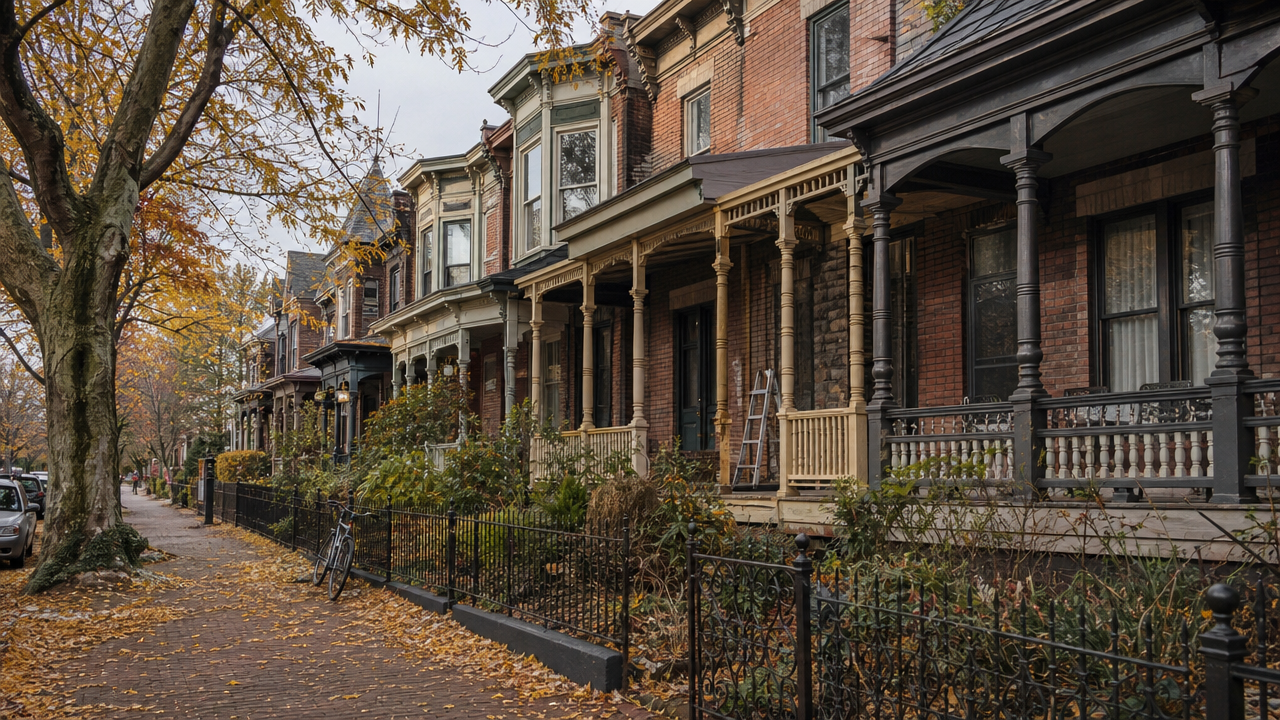
Buying in Spruce Hill: Victorian Twins and the Historic Rules
Is Spruce Hill a good place to buy a house in Philly?
It is if you want an old house with a porch and a yard, close to University City, and you are ready for what comes with a 130-year-old house. Our 2026 Philadelphia Neighborhood Guide puts the Spruce Hill median at about $575K, with most sales between $350K and $1.3M. Only a few dozen homes sell here in a year, so that median moves around, and a range tells you more than one number. Before you fall for a porch, find out whether the house sits inside the historic district the city created in 2024, because that changes what you can do to the outside of it.
Spruce Hill runs roughly from 40th to 46th Street, between Market Street and Baltimore Avenue, in West Philadelphia. The housing is mostly late-1800s Victorian twins and singles, many with front porches and real yards, which is rare this close to Center City. Penn and the University City hospitals are a short walk east, and the 34 trolley (now signed T2) runs down Baltimore Avenue into Center City. Clark Park is the neighborhood's living room, with a Saturday farmers market and Shakespeare in the summer, and Baltimore Avenue is the main strip for restaurants and coffee. Our guide gives it a Walk Score of 94 and a Transit Score of 89.
What your money buys
That $575K median hides a split. Fully restored Victorians, the big twins and singles with original woodwork and updated systems, often trade above $1M. Closer to campus you will find more condo conversions and houses that have been run as rentals for years, which is where most of the lower end of the range sits. In between are houses that are livable but dated, and that is where buyers with patience and a renovation budget tend to do best.
Old houses here come with old-house findings. Knob-and-tube wiring, slate roofs and stone foundations show up on inspection reports all the time, along with original plumbing that has been patched more than once. None of that has to kill a deal, but it should shape your offer and your budget. Give your inspection real time, add a sewer scope since the sewer line to the street is yours to fix, and read what to do when the inspection report comes back long before you are in the middle of it. If the house has been a rental, ask what was permitted and when.
The historic district rules
On July 12, 2024, the Philadelphia Historical Commission voted unanimously to create the Southeast Spruce Hill Historic District, about 572 properties bounded roughly by Spruce Street, 39th Street, Baltimore and Woodland Avenues, and 43rd Street. About 250 other Spruce Hill properties were already listed one by one on the Philadelphia Register. If a house is on the Register, either way, changes to the outside need the Commission's approval: windows, doors, porches, roofing, cornices, masonry pointing, fences, and additions. Interior work does not, and neither does routine maintenance like scraping and repainting wood trim.
In practice, the review is free, it happens when you apply for the building permit, and city staff sign off on more than 90% of applications without sending them to a hearing. Existing vinyl windows can stay; you deal with the rules when you replace them. The cost is in materials, since the Commission can ask for historically appropriate windows and doors. One owner in another district was quoted $8,500 or more for an accurate replacement front door. The rules are enforced, too: owners of a row of houses on the 300 block of South 41st Street settled porch violations with the city in July 2026 and were given 90 days to get permits.
The district has also been in court. Some property owners appealed the designation, the Court of Common Pleas denied that appeal in December 2025, and an appeal to the Commonwealth Court was still pending as of the Commission's mid-2026 report. Until a court says otherwise, assume the rules apply. The whole neighborhood also sits inside a National Register district, which on its own does not limit what a private owner does with a house. If you looked at Chestnut Hill, it is the same distinction: the city's Register is the one with teeth. Before you offer, have the Historical Commission staff confirm whether the address is designated, and budget for the exterior work you have in mind.
What's changing, and where else to look
Clark Park is getting a $1.4M upgrade. The money was approved in August 2025, public bathrooms went in that November, and the city and the Friends of Clark Park are finishing a new playground design by the end of 2026, with construction slated to wrap in 2027. Under SEPTA's trolley modernization, the tunnel routes, including the 34, are first in line for construction, with new accessible trolleys on every modernized line by 2031. Expect some service disruptions along the way, and better stops at the end.
Who Spruce Hill fits: buyers who want character, a porch and some outdoor space, and a walk or trolley ride to work, and who are fine taking on an older house. Who it does not: buyers who want new construction, a garage or a roof deck, or the freedom to change the front of the house however they like. If you love the housing but not the price, Cedar Park, just west of 46th Street, has similar twins, and Redfin put its median in the high $300s in early 2026. If you want a renovated row closer to Center City, Graduate Hospital runs about $655K in our guide and Fairmount about $490K, both with less yard and fewer porches.
Frequently Asked Questions
How much does a house cost in Spruce Hill?
Our 2026 Neighborhood Guide puts the Spruce Hill median at about $575K, with most sales between $350K and $1.3M. Restored Victorian twins and singles often sell for more than $1M, while condo conversions and older rental houses make up most of the lower end. Only a few dozen homes sell in a year, so prices swing from quarter to quarter.
Is my Spruce Hill house in a historic district?
It may be. The Southeast Spruce Hill Historic District, created in July 2024, covers about 572 properties between Spruce Street, 39th Street, Baltimore and Woodland Avenues, and 43rd Street. About 250 other Spruce Hill properties are individually listed on the Philadelphia Register. Ask the Historical Commission staff to confirm the address before you buy.
What needs approval in a Philadelphia historic district?
Exterior changes do: windows, doors, porches, roofing, cornices, masonry pointing, fences and additions. Interior work and routine maintenance, like scraping and repainting wood trim, do not. The review is free, it happens with your building permit application, and city staff approve more than 90% of applications without a hearing.
What should I look for when inspecting an old Spruce Hill house?
Knob-and-tube wiring, the condition of a slate roof, stone foundation walls and moisture in the basement, old plumbing, and the sewer line to the street. If the house was a rental, ask which work was permitted. A sewer scope and a roofer's look at the slate are worth the extra cost.
If you are weighing Spruce Hill against other parts of the city, our Philadelphia Neighborhood Guide lays out prices, housing stock and walkability for all twenty neighborhoods we cover, side by side.